
A Proposal, Not a Requirement
On October 26, 2026, Americans for Responsible Innovation (ARI), a policy advocacy nonprofit, published a proposal by Aaron Dorshow and Iskandar Haykel asking Congress to create an early-warning system for automated AI research and development. It builds on ARI's August blueprint. The post cites no introduced bill or agency action, and it creates no legal obligation.
What Developers Would Report
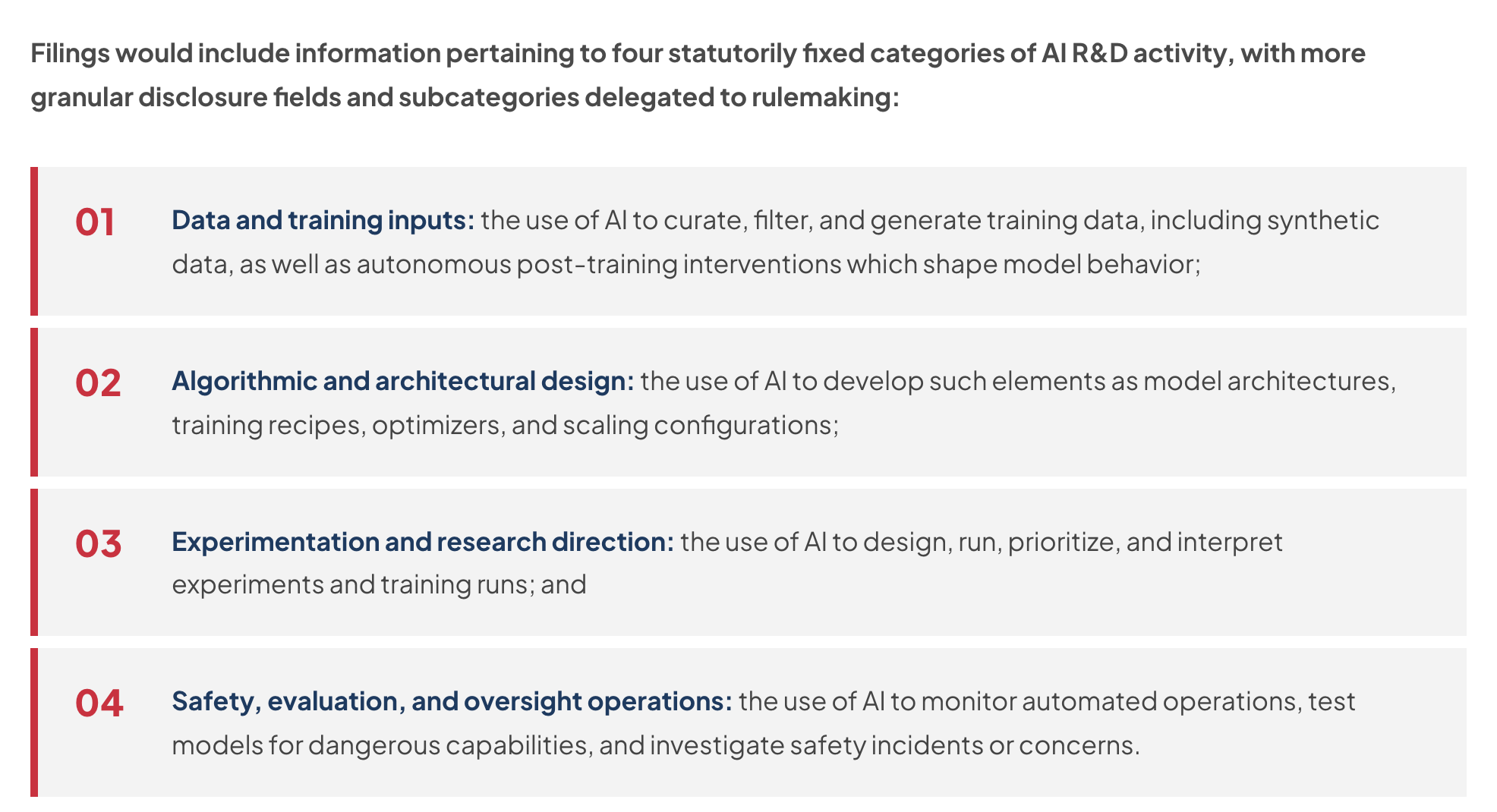
A new Commerce Department office would receive confidential quarterly filings from major frontier developers in four categories that the statute would fix: data and training inputs; algorithmic and architectural design; experimentation and research direction; and safety, evaluation, and oversight operations. Filings would rest on quantifiable measures, such as the share of computing power applied to autonomous activities and the share of AI-generated inputs and decisions that humans review.
Between quarters, developers would report a material shift within four business days of discovering it, or of when their own monitoring should have revealed it. Initial triggers could include full automation of a research loop. Filings would be exempt from the Freedom of Information Act, and the office would publish aggregate industry reports. It could refer knowingly false or incomplete filings to the Department of Justice, with a whistleblower program as a backstop.
Measurement Questions
ARI cites Anthropic's August 2026 figures, in which Claude "leads" 26 percent of Anthropic's AI research work on a prototype index. Anthropic notes that labs lack a common method and that it used its own models to rate its systems. The ARI post calls its measures auditable but does not say who would audit them, and the public would see only aggregates. See also the Cantwell audit framework and Pennsylvania's audit bills.
Follow Audit Commons
Keep up with new reporting, practical guides, and resources in your feed reader.